A freezer incident creates a chain of decisions: confirm the failure, identify affected material, reserve safe space, dispatch a responder and reconcile custody. Night Shift explores how that chain can be coordinated without making a language model the authority on operational state.
Project 04 / Night Shift
AI can recommend the response. Deterministic systems control what is allowed.
The project
A multi-agent incident response system that coordinates research-freezer rescue from alarm to reconciled custody.
The operational problem
The alarm is only the beginning.
The boundary
A recommendation is not permission to act.
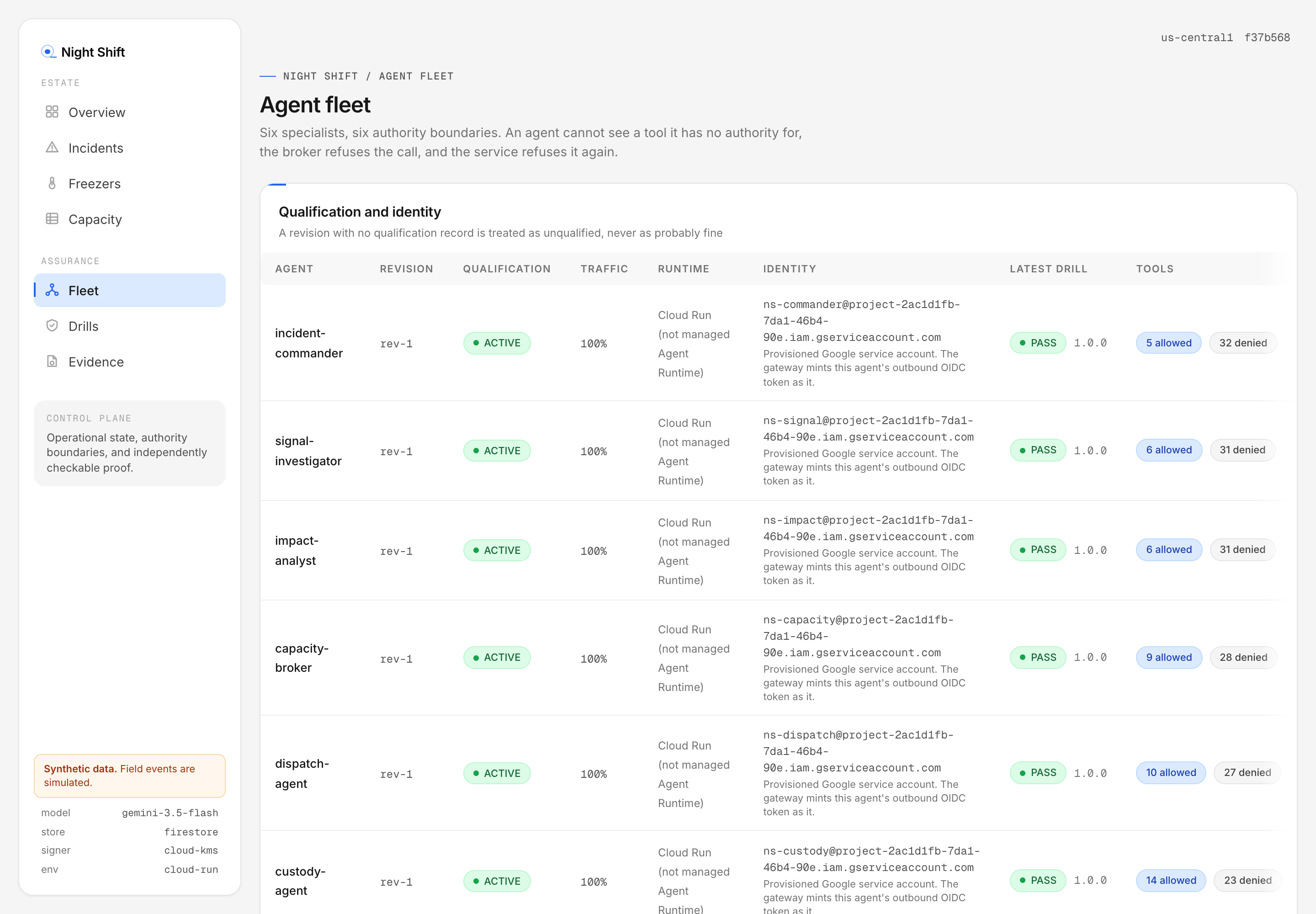
Specialist agents interpret evidence and propose the response. A tool broker restricts what each identity can reach. The deterministic Rescue Safety Kernel checks whether a state change is allowed before a domain service commits it.
The specialists
Separate responsibilities. Explicit authority.
An Incident Commander coordinates signal investigation, impact analysis, capacity, dispatch and custody specialists. Dispatch cannot access specimen inventory. Capacity reservations and custody changes belong to different agents and services.
- 01Incident Commander
- 02Signal Investigator / Impact Analyst
- 03Capacity Broker / Dispatch Agent
- 04Custody Agent
The action path
Every effect has a precondition and a receipt.
Proposed actions pass identity restrictions and safety checks before transactional services change state. Idempotent operations return an existing receipt on a repeated action. Incident progression depends on the required evidence, including complete custody reconciliation.
- 01Incident evidence
- 02Specialist proposal
- 03Identity-scoped tool broker
- 04Deterministic safety kernel
- 05Domain service transaction
- 06Immutable receipt
The assurance plane
Evidence that can be checked again.
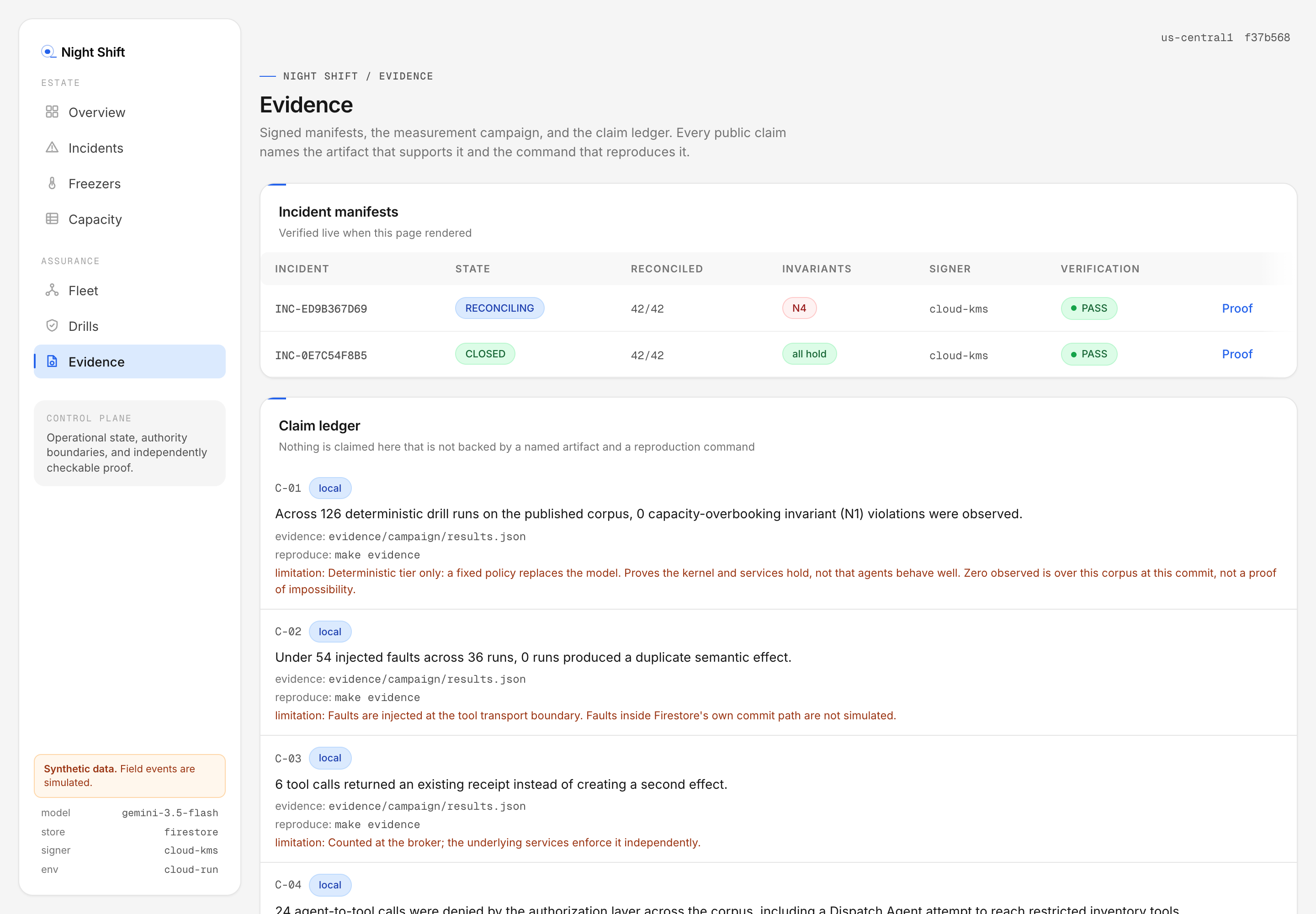
Cloud Run services use distinct service accounts. Firestore transactions enforce operational state; Cloud KMS signs evidence manifests. The offline verifier recomputes safety checks from the recorded snapshot without calling a model. An unsigned manifest is reported as partial, not a pass.
The research
A working research system, with its limits visible.
The public product exposes incident operations, the fleet permission matrix, disaster drills and an evidence ledger. It uses a synthetic estate, specimens and responders: no real samples are moved. Studio R&D gives us a place to test agent architectures and operational boundaries before applying them to a live business.
What shipped
- Incident operations interface
- Six specialist agents with separate permissions
- Identity-scoped tool broker
- Deterministic safety kernel
- Transactional capacity and custody services
- Signed evidence and offline verifier
Evidence
- Live research product (opens in a new tab)
- Public source (opens in a new tab)
- Multi-agent workflow with explicit safety boundaries
What changed
Agents coordinate an incident from alarm to reconciled custody, and every state change passes a deterministic check before it commits. Exercised against a synthetic estate.
Next project
PACT